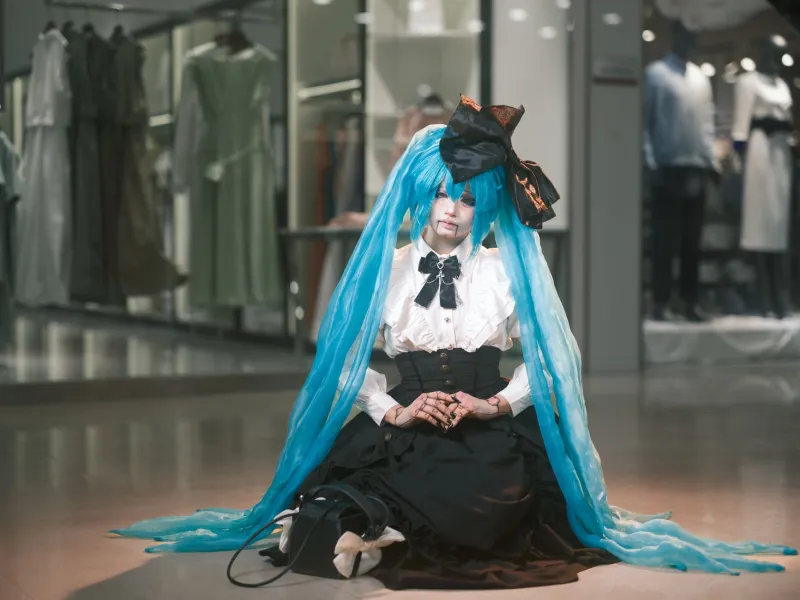
When Your Therapist Thinks the Aesthetic Is the Problem: Navigating Mental Health Care as a Goth Loli Person

Let's be honest about something most wellness content won't touch: walking into a therapist's office in a Victorian-inspired coord and watching their expression shift is its own kind of exhausting. Before you've said a single word about what you're actually there for, you're already doing emotional labor — managing their assumptions, pre-defending your wardrobe, calculating whether it's worth explaining what a JSK even is.
For a lot of goth loli folks in the US, this is just... Tuesday. And it's a real barrier to getting care that actually helps.
This isn't a piece about whether goth loli is inherently therapeutic (though honestly, for many of us, it is). It's about the messier, more practical reality of seeking mental health support when your identity sits outside what most clinical training ever prepared providers to understand.
The Misread That Costs You
The most common frustration we hear from community members isn't outright hostility — it's subtle misreading. A therapist who interprets your love of dark imagery as a symptom rather than a creative language. A psychiatrist who assumes social isolation when you describe preferring tea parties with five close friends over crowded bars. A counselor who gently suggests that "toning things down" might help your anxiety, not realizing that your coord is one of the few places you feel completely, powerfully yourself.
This kind of clinical misalignment has real consequences. People delay care, drop out of treatment early, or spend sessions managing their provider's learning curve instead of doing actual healing work. Some get misdiagnosed entirely — depression flagged where there's actually just burnout from constantly code-switching between the mainstream world and the one that actually fits.
The frustration is valid. And it's not your job to fix it alone.
What You Can Actually Do Before the First Appointment
Advocating for yourself in mental health spaces starts before you're even in the room. A few things that genuinely help:
Be upfront in your intake forms. Many therapists now include questions about identity and culture. Use that space. You don't need to write an essay, but a line like "I'm part of an alternative fashion subculture that's central to my identity and wellbeing" sets a baseline expectation that this is something they'll need to understand, not assess.
Ask direct questions during consultations. Most therapists offer a free intro call. Use it. Ask things like: "How do you approach clients whose cultural or community identity falls outside mainstream norms?" or "Are you familiar with alternative subcultures or have you worked with clients in them?" Their answer — and their tone — will tell you a lot.
Look for therapists with specific experience. The Psychology Today therapist finder lets you filter by specialty. Search terms like "alternative identity," "LGBTQ+ affirming" (many goth loli folks sit at intersections of queer identity), "creative expression," or "cultural sensitivity" can surface providers who are more likely to meet you where you are. Open Path Collective offers reduced-cost therapy and has a broad enough network to make this filtering worthwhile if budget is a concern.
Don't skip the vibe check. Competence matters, but so does feeling like a person in the room rather than a case study. If a therapist seems more curious about your outfit than your actual presenting concerns after the first session, it's okay to move on.
The Subculture as Soft Infrastructure
Here's something that doesn't get said enough in clinical spaces: for a lot of goth loli people, the community itself functions as a form of mental health support — and that's not a workaround, it's a legitimate resource.
The sense of belonging that comes from finding your people in this aesthetic is not trivial. Research on identity-affirming community consistently shows that feeling seen and understood in your full self is protective against depression and anxiety. Tea parties, online discords, convention meetups, coordinate feedback threads — these aren't just fashion activities. They're spaces where you don't have to explain yourself, where the baseline assumption is that you belong.
For a lot of us, especially those who grew up in places where alternative aesthetics were actively mocked or policed, that kind of unconditional belonging is genuinely healing. It doesn't replace professional care when professional care is needed, but it's real, and it counts.
Several community-adjacent resources have started acknowledging this explicitly. The Peer Support Space (thepeersupportspace.org) and 7 Cups both offer peer listening that doesn't require you to justify who you are to a credentialed stranger first. Reddit communities like r/mentalhealth and niche alt-fashion adjacent spaces often have pinned resources for community members specifically. And social media — for all its chaos — has produced some genuinely thoughtful goth loli creators who talk openly about therapy, medication, neurodivergence, and mental health without the aesthetic shame that sometimes creeps into mainstream wellness content.
Teaching Your Therapist Without Doing All the Work
Sometimes you find a therapist you click with and they just... don't know much about your world. That's workable, if they're genuinely curious and not defensive about it.
A few community-tested strategies:
- Bring artifacts, not just descriptions. Show them a photo of a coord you love and explain what it means to you. Visual context can communicate faster than words, especially when you're trying to convey something as layered as the emotional relationship between identity and dress.
- Name the function, not just the form. Instead of "I love gothic lolita fashion," try "There's a specific way I feel when I'm fully dressed in my aesthetic — grounded, expressive, like I'm operating from my actual self. I want to understand that better." That's language most therapists can work with.
- Set a boundary around pathologizing. You're allowed to say, directly: "I want to make sure we're treating my mental health, not my fashion choices. My aesthetic is part of who I am, not a symptom of something else." A good therapist will respect that framing.
You Deserve Care That Fits
The goth loli community has always been about creating space for selves that the mainstream didn't have room for. That same energy applies here. You deserve mental health support that treats your whole identity as valid — not a puzzle to solve, not a phase to grow out of, not a red flag to document.
That support exists. Finding it might take patience, a few awkward consultations, and some firm self-advocacy. But the bar is not "a therapist who tolerates your aesthetic." The bar is a provider who understands that your aesthetic is part of your wellness, not opposed to it.
Your frills are not the problem. Don't let anyone — in or out of a clinical setting — convince you otherwise.